A former flood-prone car park in front of the Däichhal has been transformed into a greener, cooler and more welcoming public space through the Cool Neighbourhoods project.
The completed pilot shows how urban climate adaptation can address several challenges at once. Across approximately 12,000 m², Ettelbruck has combined heat reduction, flood resilience, biodiversity, accessibility and public use in one prominent central location.
Why this site needed to change
Before the transformation, the area was dominated by a large, sealed car park with approximately 350 spaces. There was little vegetation or shade, and the extensive hard surface contributed to high temperatures during hot weather. The site was also susceptible to flooding, making it an important location in which to demonstrate a more climate-resilient approach to public space.
The car park nevertheless served a familiar urban function beside the Däichhal, a major venue used for events. Rethinking such a visible site therefore required more than a strong technical design. It also needed political support, careful stakeholder engagement and clear communication about why the change was necessary and what the city would gain.
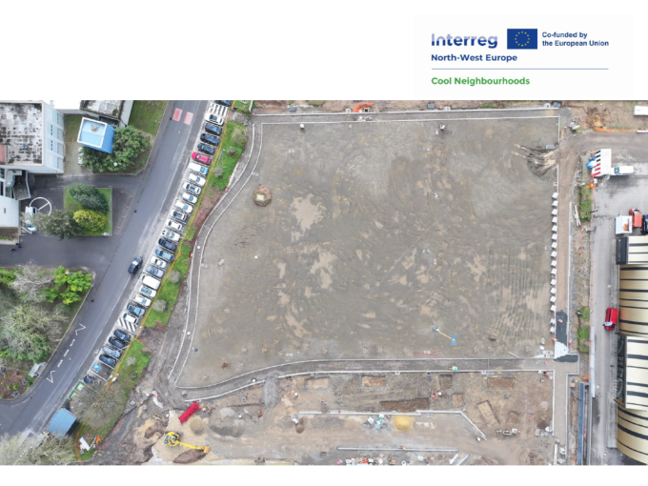
The former hard-surfaced site during the transformation towards a multifunctional green public space. Image: City of Ettelbruck / Cool Neighbourhoods.
A new covered car park with around 450 spaces had already been completed. This gave the city a practical alternative and allowed the surface car park to be reconsidered without treating the removal of parking as an isolated measure.
Creating a multifunctional green space
The pilot replaced a single-purpose hard surface with a landscape designed to perform several functions at the same time. Vegetation and permeable surfaces help reduce heat and improve how the site responds to water. More green cover also creates better conditions for biodiversity and contributes to improved air quality.
Fourteen climate-resilient tree species were planted, many of them native or regional. The species were selected for their ability to cope with both heat and flooding. To support the young trees, their trunks were coated with white paint, reducing surface temperatures by around 4–5°C, while “camel bags” provide targeted irrigation during establishment.
The transformation also made use of material already on site. Former grass-covered paving stones were removed, partly crushed and reused as base material for the new landscape. This reduced the need for new material and allowed part of the old grey surface to contribute directly to the green redevelopment.
A place for people as well as nature
The completed space is designed for everyday movement, community life and events as well as climate adaptation. A new LED-lit ramp improves accessibility to the Däichhal. Seating can support outdoor performances, informal meetings and social activities, while pedestrian connections form part of the wider consideration of cycling and public transport links.
These measures work together. Trees and planting provide shade and support nature; permeable areas and flood-aware design strengthen resilience; and accessible routes and seating ensure that the investment is visible and useful to residents. The result is not simply a park, but a flexible public landscape that can respond to environmental risks while continuing to serve the city.
Clear communication helped build support
Removing approximately 350 parking spaces from a prominent central location was politically sensitive. Jean-Paul Schaaf, First Alderman of Ettelbruck, has acknowledged that this was not an easy discussion for the mayor, aldermen or municipal council. The covered car park was important, but so too was explaining the wider purpose of the transformation.
Sacha Oberweis, General Coordinator of the City’s Technical Services, placed clear communication at the centre of the process. Rather than presenting the pilot as an abstract climate measure, the city could show the practical benefits: more trees and shade, better access, a more attractive setting, space for public activities and stronger resilience to heat and flooding. The strong public acceptance recorded by the city demonstrates the value of making those benefits understandable and visible.
Investment in Ettelbruck’s first Interreg project
The total investment in the transformation was €995,814. Interreg North-West Europe reimbursement amounts to €597,488.40, while Luxembourg national funding contributes a further €288,500. National support was provided through Méi Natur an eise Stied an Dierfer, which helps municipalities replace sealed surfaces with green infrastructure.
This is Ettelbruck’s first Interreg project. Alongside the physical redevelopment, it gives the city direct experience of European cooperation and provides the Cool Neighbourhoods partnership with a completed example of practical urban climate adaptation.
Lessons for other municipalities
The design responds to Ettelbruck’s own needs, but the process offers useful lessons for other towns and cities:
- Engage stakeholders early and build political support before positions become fixed
- Communicate trade-offs transparently and explain the benefits residents will experience
- Plan heat mitigation, biodiversity, mobility, accessibility and flood adaptation together
- Reuse existing materials where this is technically appropriate
- Make climate adaptation visible through improvements to familiar public places
- Plan from the outset for irrigation, maintenance and long-term community use
From Grey to Green
Ettelbruck has turned a large, sealed and flood-prone car park into a greener public landscape at the heart of the city. The transformation shows that climate adaptation can cool urban space, strengthen biodiversity, improve access and create opportunities for public life at the same time.
For municipalities across North-West Europe, the pilot provides a clear example of how political leadership, integrated technical planning and public communication can turn a difficult urban trade-off into a widely supported and visible improvement.
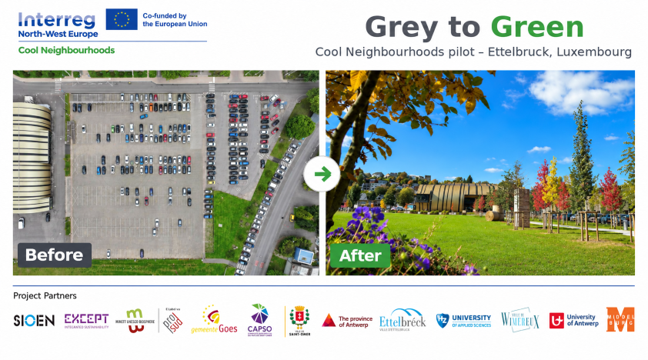
From Grey to Green – the former car park and the completed Cool Neighbourhoods pilot in Ettelbruck, Luxembourg.