The Cool Neighbourhoods e-learning and capacity-building programme helps municipalities understand heat stress and develop practical approaches for creating cooler, more liveable neighbourhoods.
As European cities and towns experience rising temperatures, more frequent heatwaves and increasing pressure on urban environments, municipalities are facing a growing challenge: how to effectively respond to heat stress while continuing to create attractive, healthy and liveable places for people to live, work and visit.
Many municipalities recognise the need to act but often face a common question…….
Where do we start?
How do regional authorities and municipalities identify priority areas? Which measures are most effective? How can residents and stakeholders be involved? How can investment decisions be justified? And how can progress be monitored over time?
To help answer these questions, the Province of Antwerp, together with partners from the Cool Neighbourhoods project, has developed a comprehensive e-learning and capacity-building programme designed specifically to help municipalities translate climate knowledge into practical action.
Turning Knowledge into Action
The programme was developed through consultation with municipalities and climate adaptation experts, ensuring the content addresses real-world challenges faced by regional authorities and municipalities across North West Europe.
Heat stress is no longer simply an environmental challenge. It affects public health, biodiversity, infrastructure, economic activity and the overall livability of neighbourhoods.
Yet successful adaptation requires more than awareness of the problem. Municipalities need practical tools, methodologies and confidence to make informed decisions and implement effective solutions.
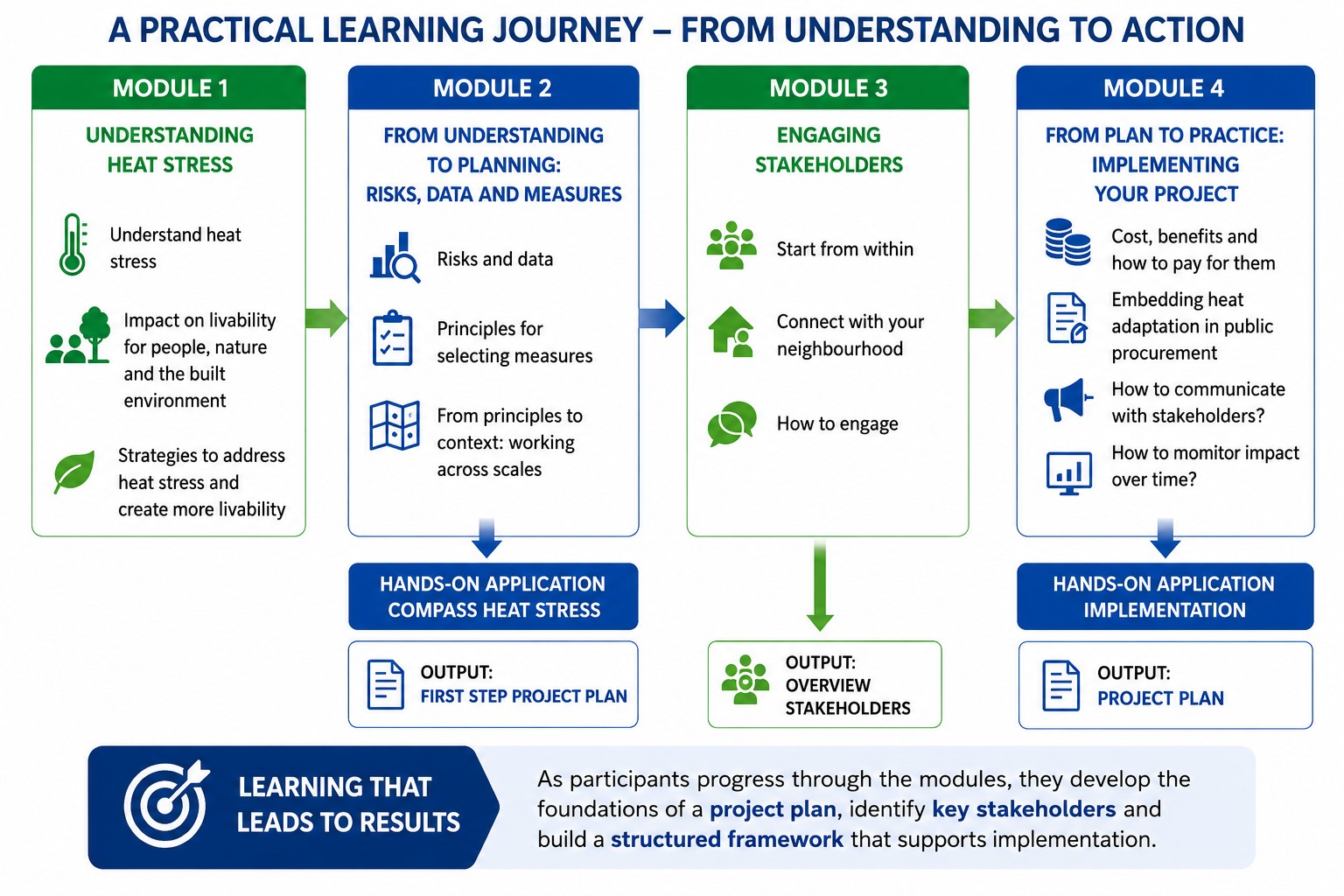
The Cool Neighbourhoods training programme was developed in response to extensive consultation with municipalities and experts. This process identified a clear need for:
- Greater awareness of heat stress impacts.
- Improved technical knowledge.
- Practical guidance on selecting interventions.
- Stakeholder engagement methodologies.
- Communication support.
- Financial and policy guidance.
- Accessible implementation tools.
The result is a structured learning journey that helps municipalities move from understanding heat stress to planning, implementation and long-term monitoring.
Supporting Municipalities at Every Stage
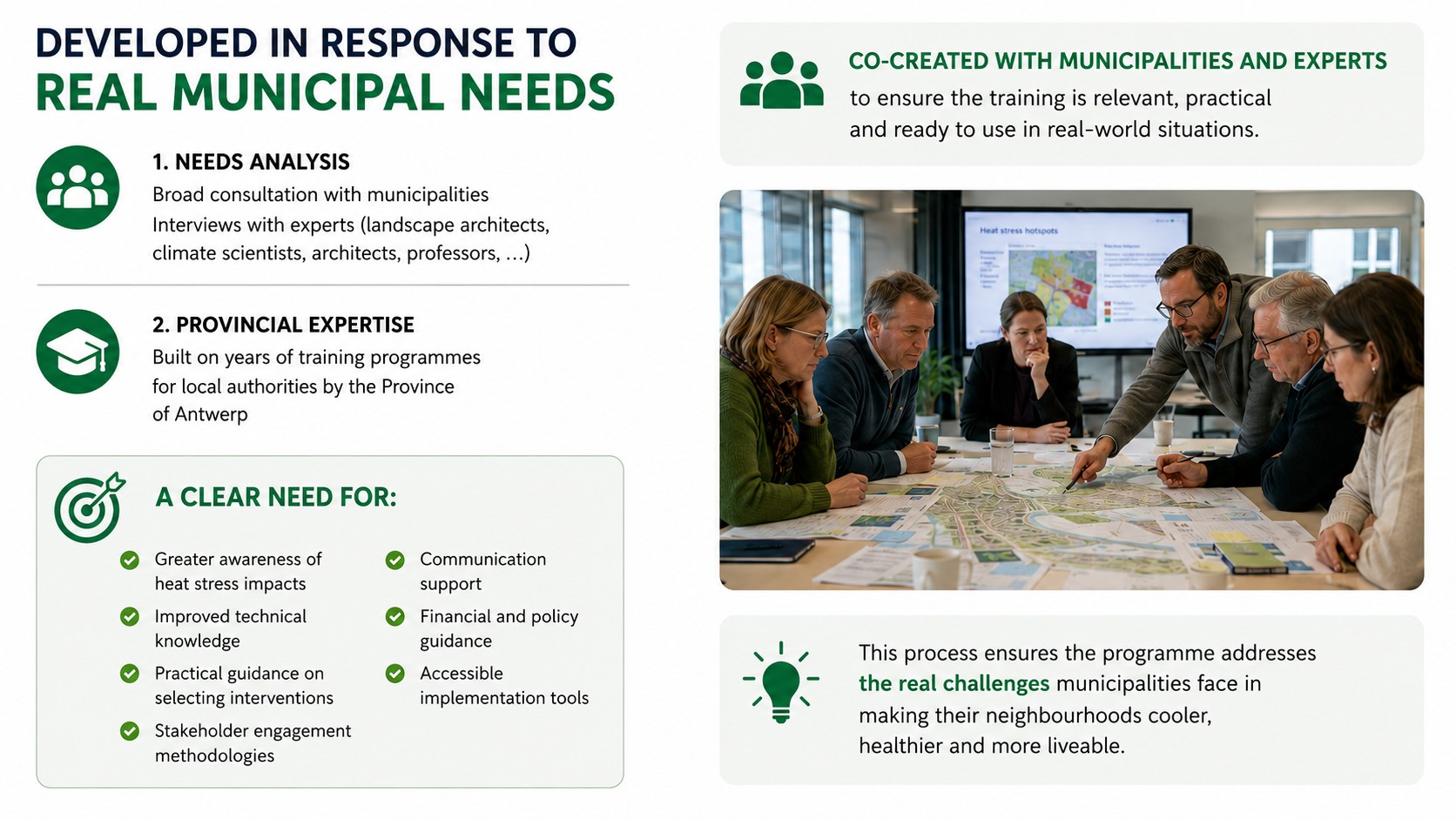
The learning journey guides municipalities from understanding heat stress through to planning, stakeholder engagement, implementation and monitoring.
The programme has been designed around the real-world challenges faced by municipalities.
Rather than presenting theory in isolation, the training follows the same decision-making process that municipalities encounter when developing climate adaptation projects.
Participants are guided through four interconnected stages.
Understanding the Challenge
Effective action starts with understanding.
The first stage explores what heat stress is, why it matters and how it affects people, nature and the built environment. Participants learn about urban heat islands, vulnerable populations, climate impacts and the relationship between heat stress and livability.
Most importantly, municipalities gain a clearer understanding of why heat adaptation should be considered an integral part of urban planning, public health and neighbourhood development.
Identifying Opportunities and Priorities
Module 2 introduces practical approaches for identifying risks, analysing data and selecting appropriate measures to address heat stress.
Once the challenge is understood, municipalities must determine where action is most needed.
The programme introduces practical approaches for identifying vulnerable locations, analysing local climate risks and using available data tools to support decision-making. Participants learn how to assess neighbourhood conditions, identify opportunities and prioritise interventions based on evidence rather than assumptions.
This helps municipalities focus resources where they can deliver the greatest impact.
Engaging Stakeholders and Building Support
Successful projects depend on collaboration.
Climate adaptation affects multiple departments, organisations and communities. The programme therefore provides practical guidance on stakeholder engagement, citizen participation and cross-departmental cooperation.
Participants are introduced to methodologies that help build ownership, encourage participation and strengthen collaboration throughout the project lifecycle.
By helping municipalities engage the right people at the right time, the programme supports more effective and widely supported interventions.
Delivering and Monitoring Results
The final stage focuses on implementation.
Participants learn how to develop Neighbourhood Heat Stress Action Plans (NHSAPs), evaluate potential measures, assess costs and benefits, identify funding opportunities and establish monitoring systems that demonstrate impact over time.
This ensures that projects do not end when construction is completed, but continue to deliver measurable benefits for residents, communities and municipalities.
Practical Learning for Real-World Challenges
A key strength of the programme is its practical focus.
Alongside the e-learning modules, participants are supported through exercises, tools and implementation guidance that help transform learning into action.
The programme introduces approaches for:
- Identifying heat hotspots.
- Selecting appropriate interventions.
- Linking adaptation projects with wider municipal priorities.
- Engaging communities.
- Assessing costs and benefits.
- Monitoring long-term outcomes.
- Embedding climate resilience within everyday decision-making.
By focusing on practical application, the programme helps municipalities build confidence as well as competence.
Creating Lasting Impact Beyond the Pilot Areas
The training programme captures practical knowledge, tools and methodologies that can support municipalities across North-West Europe in addressing heat stress and improving livability.
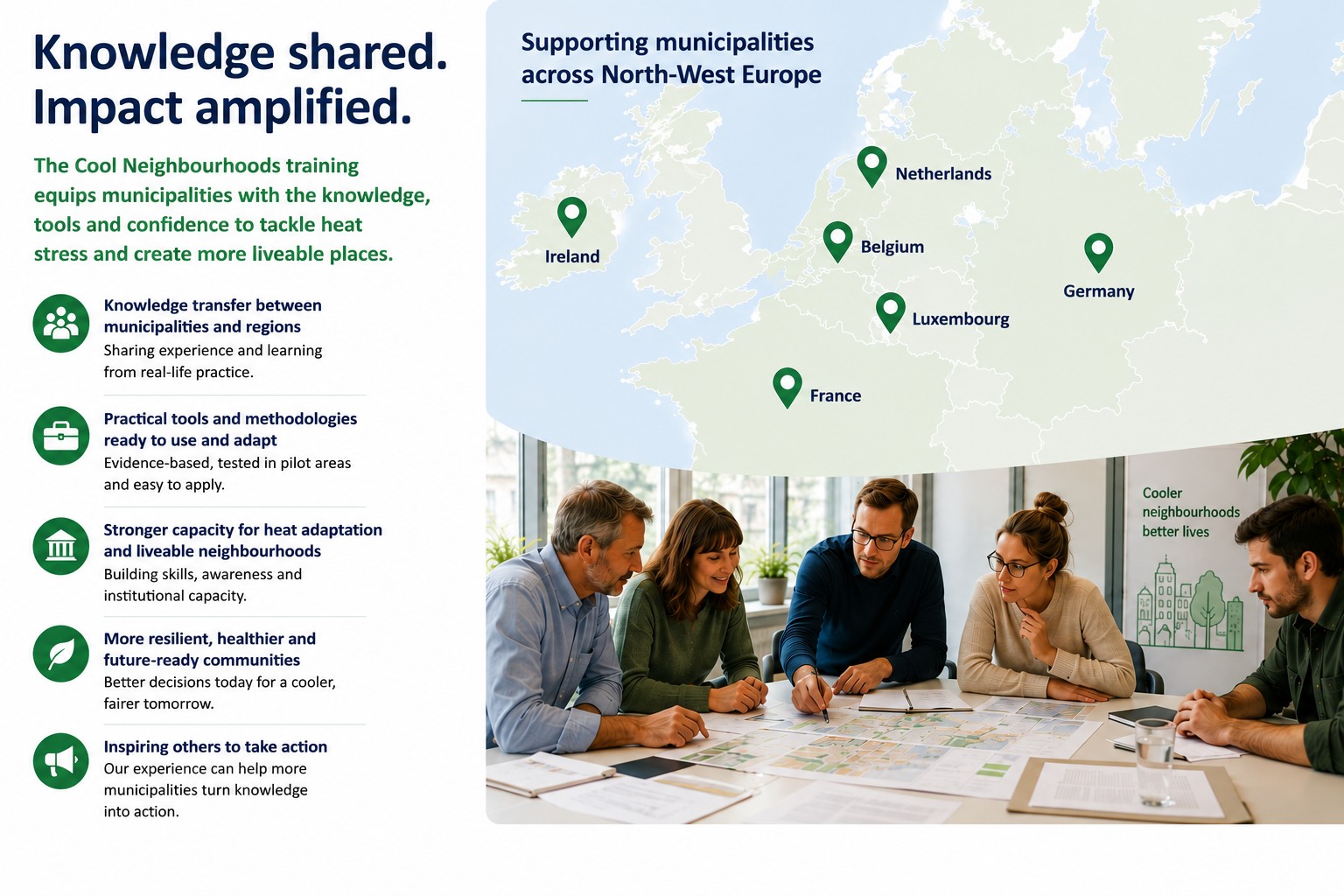
Throughout Cool Neighbourhoods, partners have generated valuable knowledge through pilot projects, testing, monitoring and stakeholder engagement activities.
The training programme captures this experience and translates it into a format that can be shared, understood and applied by other municipalities.
Its modular structure, practical methodologies and emphasis on real-world implementation create opportunities for wider uptake by municipalities seeking effective approaches to heat adaptation and improved livability.
In this way, the programme helps ensure that knowledge generated through Cool Neighbourhoods can continue to support climate action beyond the project itself.
Looking Ahead
Heat stress is becoming one of the defining urban challenges of the coming decades.
Municipalities increasingly need practical tools that help them move from understanding problems to implementing solutions.
By combining technical knowledge, planning methodologies, stakeholder engagement approaches and implementation guidance, the Cool Neighbourhoods training programme provides municipalities with a structured pathway for addressing heat stress and creating cooler, more liveable neighbourhoods.
Because building climate resilience starts with empowering those responsible for shaping the places where people live, work and connect.